

Keyboard Culture
Mechanical Keyboard Setup Guide: How to Choose the Right Artisan Keycap
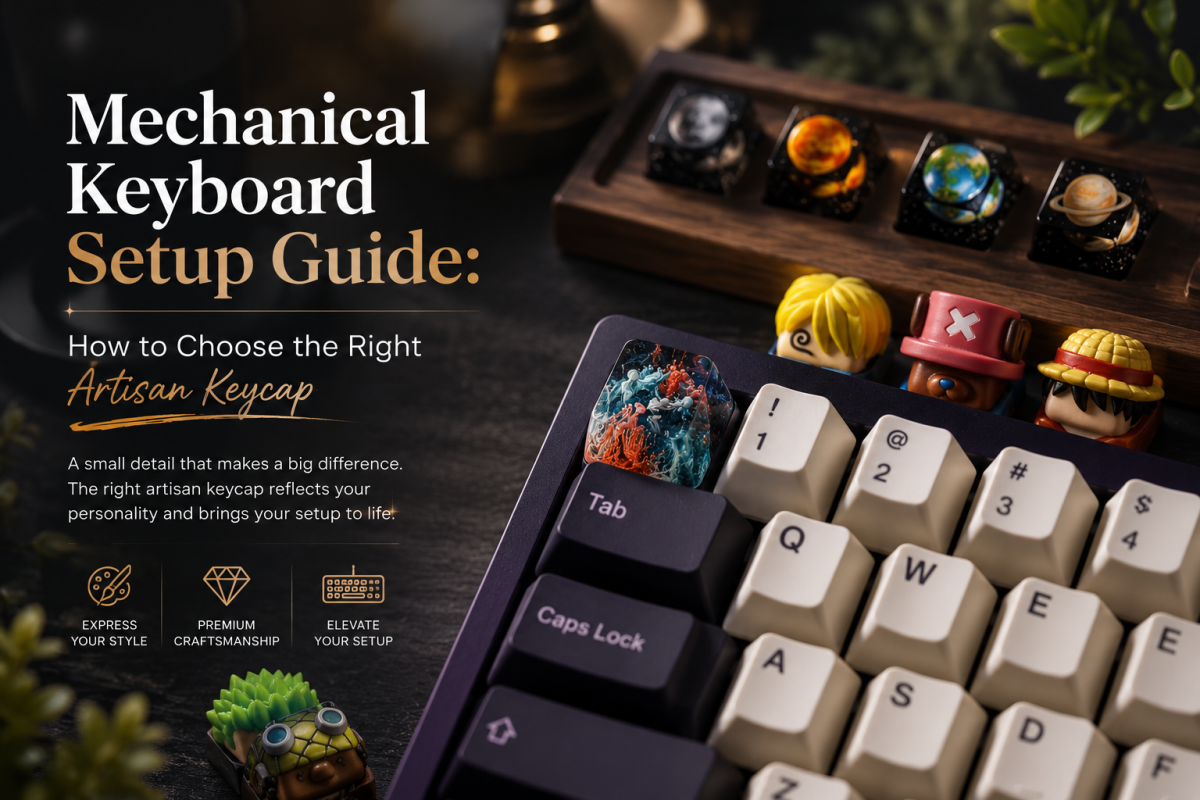
Your keyboard is the most touched object on your desk. Treat it accordingly.
The average person types over 40 words per minute. That’s thousands of keystrokes every single day — on the same keys, in the same positions, for years.
Most people never think twice about what their fingers are actually touching.
The mechanical keyboard community thinks about almost nothing else.
If you’ve found your way here, you’re probably somewhere on that spectrum — curious about artisan keycaps, wondering what the difference really is, and trying to figure out which one belongs on your setup.
This guide is for you.
First: What exactly is an artisan keycap?
A standard keycap is a plastic cap that sits on top of a keyboard switch. It’s functional. It does its job. It has a letter or symbol printed on it and that’s more or less the end of the conversation.
An artisan keycap is something else entirely.
It’s a handcrafted piece — typically made from resin — that replaces one key on your keyboard, usually the Escape key or a spacebar. Instead of a printed letter, it features a miniature sculpture, a painted scene, a galaxy, a character, a creature. Something that makes you stop and look.
At DATKEYstudio, our artisan keycaps are cast in high-clarity resin with hand-painted details inside. Each one is a small world contained in something the size of your thumbnail.
Compatibility: Will it fit your keyboard?
This is the first question everyone asks, and it’s the right one to start with.
Switch type is what matters most.
The vast majority of artisan keycaps — including all of ours — are designed for MX-style switches. This covers Cherry MX (the original and most widely used), as well as compatible clones from Gateron, Kailh, Akko, and many others.
If your keyboard uses MX-style switches, you’re almost certainly compatible.
What about other switch types?
Keyboards using Alps, Topre, or low-profile switches (like those found on laptop-style mechanicals) use different stem designs and are generally not compatible with standard artisan keycaps. If you’re not sure which switches your keyboard has, a quick search of your keyboard model will tell you immediately.
What about the key size?
Most artisan keycaps are designed for standard key sizes — particularly the 1U size used for the Escape key and most alphanumeric keys. If you want to place an artisan keycap on a larger key like a spacebar or shift key, check the product listing for size compatibility.
When in doubt, reach out to us with your keyboard model and we’ll confirm compatibility before you order.
Choosing your theme: The real decision
Once you’ve confirmed compatibility, the fun begins.
Choosing an artisan keycap isn’t like choosing a phone case. It’s closer to choosing a piece of art for your wall — except this one lives on your desk, in your hands, in your daily experience.
Here’s how to think about it.
Consider your overall setup aesthetic.
Look at your desk as a whole. What’s the vibe? Dark and moody with RGB lighting? Clean and minimal with a monochrome palette? Warm wood tones with natural textures?
Your keycap should feel like it belongs in that world — not fight against it.
A Galaxy keycap with deep purples and cosmic blues works beautifully on a dark setup with cool-toned lighting. A nature-inspired keycap with amber and green tones might feel more at home on a warm, wooden desk.
Consider what you’re drawn to.
This sounds obvious, but it’s worth saying: get something you actually love looking at.
You’re going to see this keycap every single day. It should make you feel something. Maybe it’s a character from your favorite game. Maybe it’s an astronaut floating through space that reminds you to keep perspective. Maybe it’s a dragon that you’ve been obsessed with since you were twelve.
The best artisan keycap is the one that makes you smile every time you sit down at your keyboard.
Consider how the keycap is lit.
Many mechanical keyboards have per-key RGB lighting. If yours does, think about how the light will interact with your keycap.
Our resin keycaps are designed to allow light to pass through them — creating a glow effect that makes the scene inside appear to be lit from within. On a backlit keyboard, this effect can be spectacular. On a non-backlit keyboard, the keycap still looks beautiful, just without the added drama of the light interaction.
Placement: Where does it go?
The Escape key is the traditional home for artisan keycaps — top-left corner of the keyboard, visible at all times, out of the way of your primary typing zone so it doesn’t interfere with your workflow.
But there are no rules here.
Some people place their artisan keycap on a key they rarely use — a function key, a tilde, a right-side modifier. Others prefer to put it somewhere more central, where it becomes the clear focal point of the entire setup.
Experiment. Move it around. See where it feels right.
Your keyboard is your space. Own it.
Caring for your artisan keycap
A resin artisan keycap is more delicate than a standard ABS or PBT keycap, and deserves a little more care.
To clean it: Use a soft microfiber cloth lightly dampened with warm water. Gently wipe the surface. That’s all it needs.
To protect it: Avoid placing it on a keyboard that gets exposed to direct sunlight for extended periods — UV light can yellow resin over time. Keep it away from harsh chemicals and alcohol-based cleaners.
To remove it: Use a keycap puller — the wire kind, not the plastic ring type — and pull straight up gently. Never twist or force it.
Treat it well and it will stay beautiful for years.
The bigger picture
A mechanical keyboard setup is one of the most personal spaces most people create.
It’s where you work. Where you play. Where you write, create, communicate. The objects on that desk — the ones you interact with every single day — shape your experience of all those things in ways that are easy to overlook.
An artisan keycap is a small thing. One key out of 60, 80, or 100.
But it’s the key that says: I thought about this. I chose this. This desk is mine.
And that’s worth something.
Find your keycap → Shop Artisan Keycaps